

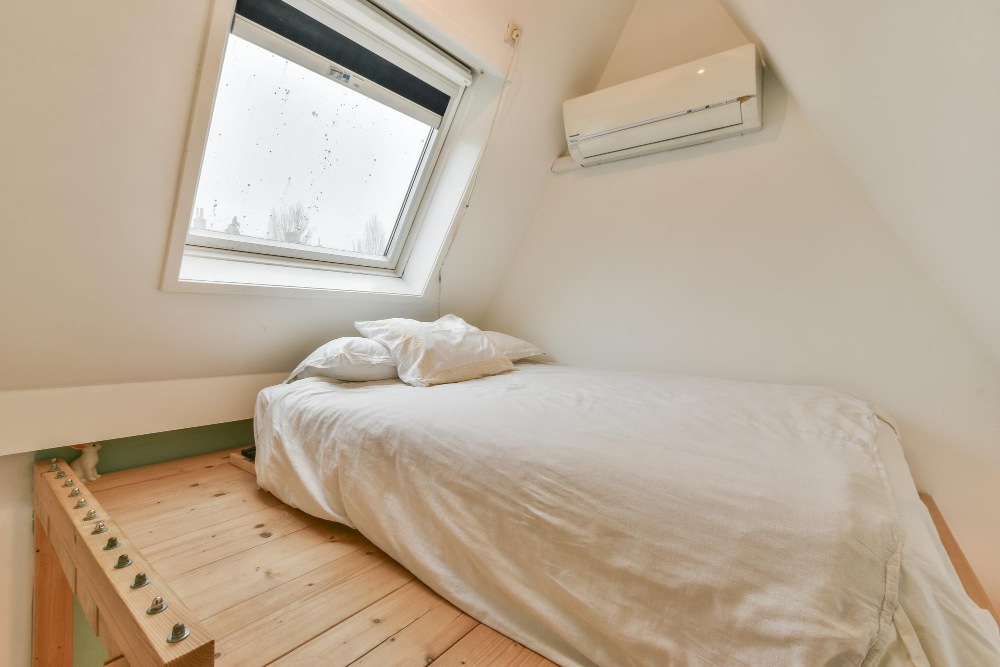
Air conditioning in the attic solves one of the most serious summer problems—the overheating of the top floor of the building. The attic heats up faster than any other room because the roof absorbs solar radiation all day long, and heat accumulates under the sloped ceilings where ventilation is limited. As a result, the temperature in the summer regularly exceeds 35°C—even if it’s bearable on the ground floor.
However, installing air conditioning in an attic presents the installer with a set of challenges not found in a typical installation in an apartment building or a single-family home with a flat ceiling. Below, we discuss the most important ones and show how to deal with them.
Why is the attic the hardest room to cool?
Three factors contribute to the attic heating up exceptionally quickly.
First, the roof—unlike the walls—receives direct sunlight for much of the day. Even a well-insulated roof transfers some of that heat into the interior. A roof with no insulation or an insufficient thermal layer acts almost like a radiator.
Second, warm air rises. Heat from the entire building naturally accumulates on the top floor.
Third, effective mechanical ventilation is rarely found in attics. Roof windows ventilate less effectively than vertical windows, and opening them in hot weather often simply lets in hot air from outside instead of cooling the interior.
As a result, an air conditioner in the attic must work harder than the same model in a comparable room on the ground floor. This directly translates to the unit’s power requirements.
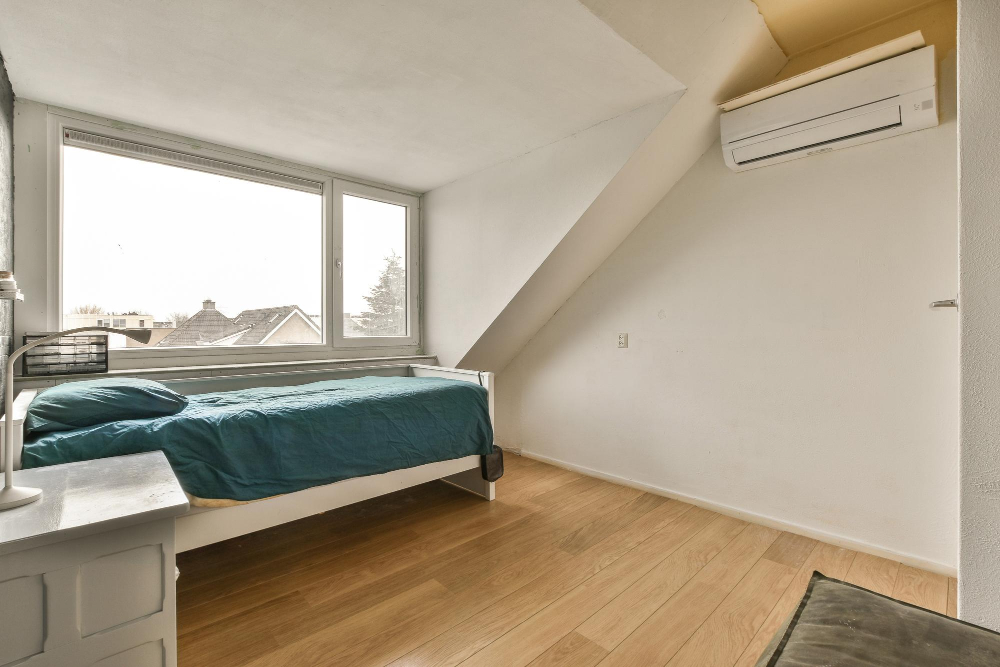
How to select the right capacity for an attic air conditioner?
Installing an air conditioner in the attic requires a different approach to capacity calculations than in a typical room. Standard conversion factors—approximately 100 W of cooling capacity per square meter—were designed for rooms with vertical walls and good insulation. In the attic, these values must be increased.
Depending on the roof’s insulation level, the roof’s orientation, and the amount of glazing, a multiplier of 1.3 to 1.6 is typically used. This means that a 30 m² room, which would require a 3 kW air conditioner in an apartment building, may need a 4–5 kW unit in an attic.
Choosing an air conditioner that is too small is a common mistake. A unit that is undersized runs nonstop at full power, never reaches the set temperature, and consumes more electricity than a more powerful model operating at partial load. A properly selected inverter air conditioner, once it reaches the desired temperature, switches to continuous operation at low power—quiet and energy-efficient.
Proper power selection requires an analysis of the specific room—its area, volume, number of windows, sun exposure, and type of insulation. Our consultants perform these calculations during the quote phase.
Where to install the outdoor unit?
This is the most challenging part of installing an air conditioner in an attic. The outdoor unit must be located outside the building, require constant service access, and be connected to the indoor unit via refrigerant pipes with the shortest possible route. In attics, it can be difficult to meet all these requirements simultaneously.
Roof Installation
Installing the outdoor unit directly on the roof is one of the solutions used in attic spaces. It requires special mounting brackets tailored to the type of roofing material—different brackets are needed for ceramic tiles, metal roofing tiles, or asphalt shingles. The brackets ensure adequate clearance and stability.
The drawbacks of this solution include limited service access and the need to verify the roof’s load-bearing capacity. The outdoor unit weighs between 25 and 50 kg depending on the model—for older roof structures, it is advisable to consult a structural engineer or construction manager.
Gable Wall Installation
If the attic has a gable wall—a vertical wall at the top of the building—this is the most convenient location for installing the outdoor unit. The unit hangs on the wall just as in a standard installation, and the piping runs through the wall. This is the solution preferred by installers when available—it is cheaper, easier to service, and does not place a load on the roof.
Installation in a different location with a longer pipe run
When neither the roof nor the gable wall is available, the outdoor unit is installed lower—e.g., on a wall below the attic, on a balcony, or on the ground. In this case, the refrigerant pipe run may be 10–20 meters or longer.
A long pipe run does not disqualify the system, but it does require attention. The system must be charged with the appropriate amount of refrigerant based on the length of the pipes. Too little refrigerant reduces cooling efficiency, while too much can damage the compressor. Therefore, a system with a long pipe run should always be designed and installed by an experienced, certified technician.
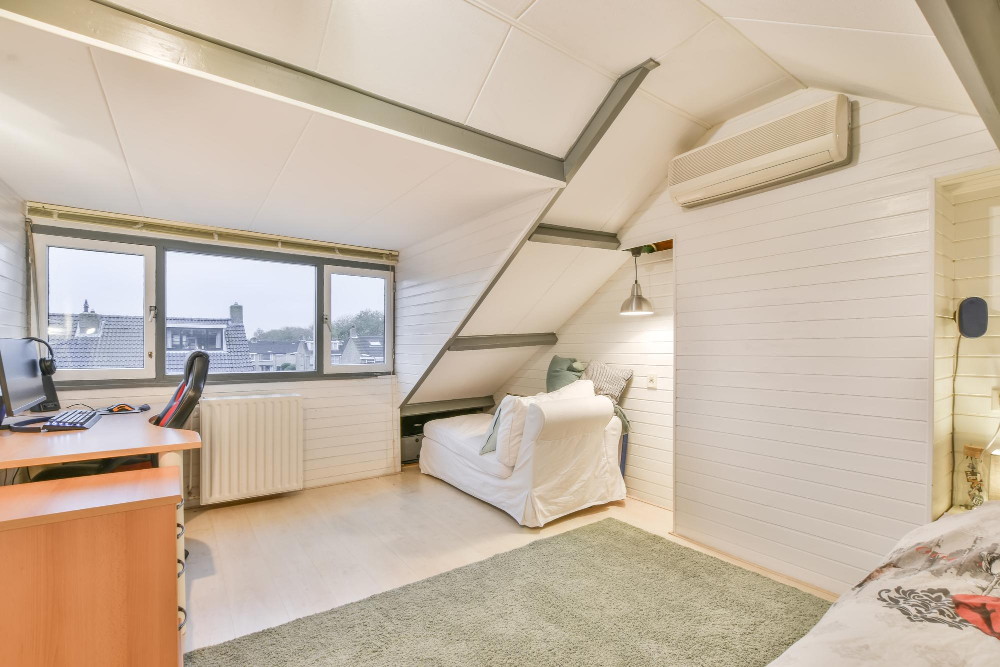
What type of indoor unit is suitable for an attic?
Wall-mounted unit (split)
The most popular and least expensive type. It is mounted on a wall—in an attic, most often on a knee wall or on one of the slanted walls between the rafters. Limitation: it requires a vertical wall of sufficient height (at least 15–20 cm from the unit to the ceiling or the next obstacle) and space for condensate drainage.
Ducted unit
In an attic with an irregular layout and limited space between the rafters, a ducted air conditioner is often a good solution. The indoor unit is concealed in the space above the suspended ceiling, and the cooled air is distributed through a network of ducts and air vents. Installation is more complex and expensive, but the unit is visually hidden and works well in large, open attics.
Cassette unit
Used mainly with flat suspended ceilings. It is less commonly used in sloped attics—it requires a minimum depth of the suspended ceiling and a perpendicular mounting surface.
What else is worth doing when installing an air conditioning system?
Roof insulation. An air conditioner struggles to combat heat seeping through an uninsulated or poorly insulated roof. A proper layer of mineral wool or polyurethane foam reduces this heat transfer by several times—and allows the air conditioner to operate with less strain. If roof insulation is insufficient, even the best air conditioner will run nonstop and fail to lower the temperature to a comfortable level.
Mechanical ventilation. A heat recovery ventilator or at least a mechanical fresh air supply system supplements the air conditioning by providing air exchange that the air conditioner alone cannot provide. An air conditioner cools and dehumidifies the air in the room, but does not replace it with fresh air. In an attic, where roof windows provide poor ventilation, mechanical ventilation is a particularly valuable addition.
Frequently Asked Questions
Does an air conditioner in an attic need to be more powerful than one in a regular room?
Yes. Standard power ratings need to be increased by 30–60% depending on roof insulation and sun exposure. An air conditioner that’s too weak runs nonstop and fails to reach the set temperature—while consuming more electricity than a more powerful unit operating at partial load.
Can the outdoor unit be mounted on the roof?
Yes, but this requires special mounting brackets suited to the type of roofing and verification of the roof’s load-bearing capacity. The preferred location is the gable wall, if available—it is cheaper to install and easier to service.
How long can the duct run be?
Manufacturers typically allow for piping runs of up to 15–25 meters without the need for additional refrigerant charging. Longer runs are possible, but require a precise calculation of the refrigerant charge by an F-Gas-certified installer.
Is an air conditioner sufficient to heat an attic in the winter?
Modern inverter air conditioners can heat effectively even at outdoor temperatures of -15°C or lower (in the case of all-season models). They work well as a supplement to a heating system. As the sole heat source in an attic, they may be insufficient during very cold winters—this depends on the model and the quality of the building’s insulation. It’s worth consulting this scenario on a case-by-case basis.
Which air conditioner should you choose for the attic: split or ducted?
A split system is a cheaper and simpler solution, sufficient in most cases. A ducted air conditioner is worth considering when the attic is large and open, there are no suitable walls for mounting a wall-mounted unit, or when you want a concealed installation. The final choice depends on the room layout and your budget.